



Architecture Implementation:
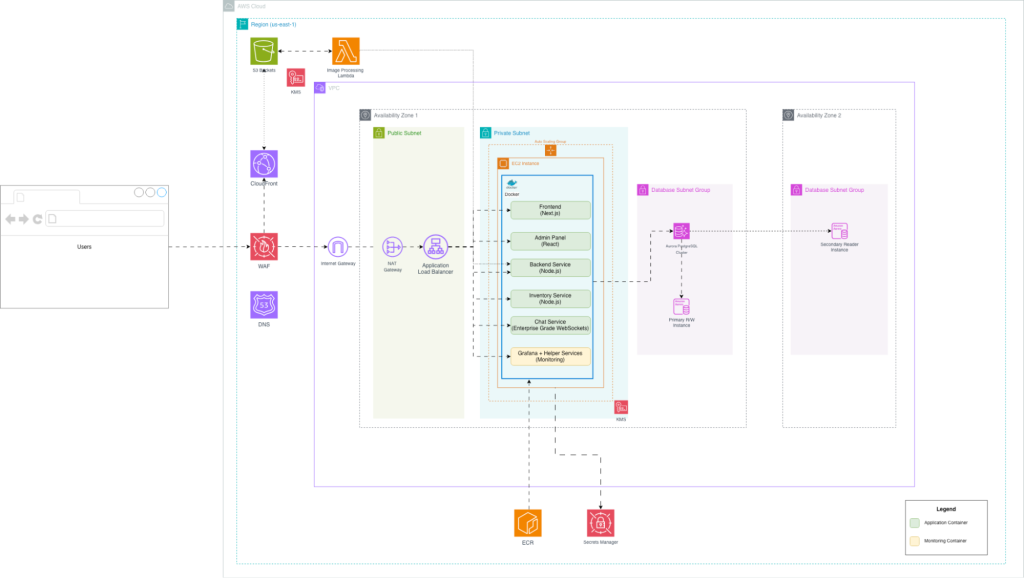
The solution leverages a range of AWS services, including Amazon EC2, Amazon Aurora PostgreSQL, Amazon CloudFront, AWS Lambda, Amazon S3, and AWS Secrets Manager, to create a secure, resilient, and flexible foundation. A containerized application stack using Docker Compose enables modular deployment and operational consistency, while integrating open-source observability tools like Grafana, Prometheus, Loki, and Fluent Bit to deliver end-to-end monitoring across metrics, logs, and system health.
Environment Setup
- VPC with public and private subnets across multiple Availability Zones for high availability.
- An EC2 instance in a public subnet hosts containerized applications using Docker Compose.
- Aurora PostgreSQL Multi-AZ in private subnets for database durability and automatic failover.
- Elastic IP attached to EC2 for static, reliable access.
Networking
- CloudFront serves static frontend assets stored in S3 for global low-latency delivery.
- Elastic IP provides external connectivity to the EC2 instance for API requests.
- Compute & Application Layer
- EC2 with Docker Compose runs multiple containers with consistent environments.
- Nginx Container handles intelligent routing between services.
Database and Application Layer
- Aurora PostgreSQL (Multi-AZ) ensures database availability, resilience, and automatic failover capabilities unavailable in the LiquidWeb environment.
- AWS Lambda function automatically compresses user-uploaded images for profile pictures and packages, optimizing storage and delivery.
Security & Access Control
- Amazon ECR hosts container images with vulnerability scanning.
- IAM policies restrict access with least-privilege principles and full auditability.
- CloudFront caches static assets globally while enforcing HTTPS.
- Security groups enforce granular access across compute and data components.
- AWS Secrets Manager stores deployment credentials and certificates securely, eliminating hardcoded secrets.
Automation & Observability
One of the most significant improvements over the LiquidWeb environment was the implementation of comprehensive automation and observability capabilities that transformed how the customer operates their platform.
Infrastructure Automation
- Entire infrastructure defined using Infrastructure as Code (IaC) with Terraform.
- All configuration files stored in Git, providing complete version history and auditability.
- GitLab pipelines automate deployment of Terraform stacks on code merges, enabling true continuous deployment.
- Every infrastructure change is tracked, reviewed, and auditable, a stark contrast to the manual, undocumented changes in the previous environment.
Monitoring & Logging
- Prometheus collects and stores time-series metrics from all application containers.
- Loki aggregates logs with FluentBit as the collection agent.
- Real-time alerting enables proactive issue detection before user impact.
Centralized Observability
- Grafana provides unified dashboards aggregating metrics and logs from all containers.
- Teams gain visibility into application performance, infrastructure health, and business metrics from a single pane of glass.
DevSecOps Best Practices
- Version-controlled infrastructure code ensures reproducibility and audit trails.
- Rolling upgrades for services minimize downtime during deployments.
- Secure secrets management with AWS Secrets Manager eliminates credential exposure risks.
- IAM policies enforce authentication requirements for all infrastructure changes.
Why AWS?
Crest Data’s recommendation to build on AWS rather than expand their LiquidWeb footprint was grounded in a thorough analysis of the customer’s current and future requirements:
Managed Services for Operational Efficiency:
Services such as Amazon EC2, Amazon RDS (Multi-AZ), CloudFront, Lambda, and S3 allowed the team to offload undifferentiated heavy lifting (patching, scaling, maintenance) tasks that consumed significant resources in the LiquidWeb environment.Seamless Continuous Deployment:
AWS’s native integration with GitLab CI/CD and Terraform enabled fully automated, repeatable deployments. Every code merge triggers automated infrastructure updates, reducing deployment time from hours to minutes.Enterprise-Grade Observability:
The integrated monitoring stack (Prometheus, Grafana, Loki) provides visibility that was simply not achievable with LiquidWeb’s basic monitoring capabilities.Superior Resource Management:
On-demand provisioning and infrastructure-as-code practices enable dynamic resource allocation, eliminating the over-provisioning required in the previous static hosting environment.Complete Auditability:
AWS CloudTrail combined with version-controlled Terraform configurations provides a complete audit trail of every infrastructure change who made it, when, and what was modified.Robust Authentication & Access Control:
AWS IAM and Secrets Manager provide fine-grained access controls with multi-factor authentication for critical infrastructure changes, significantly reducing security risks compared to the previous setup.Security & Compliance:
AWS’s built-in security features (IAM, Secrets Manager, VPC isolation) aligned with least-privilege access control, supporting compliance with industry best practices.Cost Optimization:
On-demand resources and consolidated billing through AWS Cost Explorer supported 30-40% cost savings compared to the fixed-capacity LiquidWeb hosting.
Outcomes & Success Metrics
The migration from LiquidWeb to AWS for this new venture delivered measurable improvements across all key operational dimensions:
High Availability:
- RDS failover confirmed at <60 seconds, with zero data loss via synchronous replication.
- Architecture delivers 99.99% availability, a significant improvement over the previous 99.5% SLA.
Security:
- IAM policies follow a least-privilege model, reducing risk of unauthorized access by ~40% compared to the LiquidWeb setup.
- Static assets securely delivered through CloudFront + S3 + Lambda, with Secrets Manager enforcing centralized credential control.
- Full auditability of infrastructure changes via CloudTrail and Git history.
Operational Efficiency:
- Automated CI/CD pipelines eliminated ~70% of repetitive deployment tasks, saving the operations team ~40 hours/month.
- Deployment time reduced from 2-3 hours (manual) to under 15 minutes (automated).
Observability:
- 100% of metrics and logs captured via Prometheus + Loki + FluentBit, aggregated in Grafana dashboards.
- Mean Time to Detection (MTTD) reduced by 60% through real-time alerting.
- Automated scaling and patching reduced unplanned downtime incidents by ~25% YoY.
About Crest Data
Crest Data is a data and AI-first product engineering and technology solutions company with deep expertise across Agentic and Generative AI, cybersecurity, observability, data analytics, workflow automation, and cloud platforms. With a global team of 1,200+ professionals and over 5,500 successful engagements for 150+ customers worldwide, Crest Data helps organizations build intelligent, secure, and scalable digital systems.
Supported by strategic partnerships with leading technology providers including AWS, Google, Microsoft, Datadog, Dynatrace, ServiceNow, and NetApp, Crest Data delivers AI-led engineering, accelerated cloud transformations, and outcome-driven solutions that enable enterprises to innovate faster.