

With its AWS-native architecture, the Security platform enables organizations to manage permissions at scale, enforce least-privilege access, and maintain continuous compliance while ensuring a secure, highly available cloud environment.
About the Customer
The customer is a leading multi-cloud permissions management provider recognized for its innovative identity and access governance capabilities. Their platform protects critical cloud infrastructure by offering deep visibility into permissions, continuously monitoring activity, and automatically remediating over-permissioned human and machine identities.
Customer Challenge
The customer required a secure AWS platform with stronger identity and permissions management to reduce risks from over-privileged accounts and maintain compliance at scale. Traditional IAM controls lacked visibility and automation, creating gaps in governance and security. The challenge was to design a resilient multi-AZ architecture that integrated the products Security for least-privilege enforcement and activity monitoring, while leveraging AWS-native services such as WAF, Shield, GuardDuty, KMS, and Config for protection and compliance. In addition, the platform needed unified observability through CloudWatch, Athena, Prometheus, Grafana, and ELK to ensure operational visibility and faster remediation.
Proposed Solution
Crest Data helped the customer deploy AWS and integrate Amazon CloudWatch as an Observability platform, infused with DevSecOps best practices.
Core services leverage Amazon RDS (PostgreSQL and MySQL, both Multi-AZ) for relational workloads, Amazon ElastiCache (Redis) for low-latency caching, and Amazon S3 as the foundation of a durable data lake. Encrypted EBS volumes and AWS KMS secure data at rest, while Amazon GuardDuty provides continuous threat detection. AWS Config enforces compliance by evaluating resource configurations against best practices.
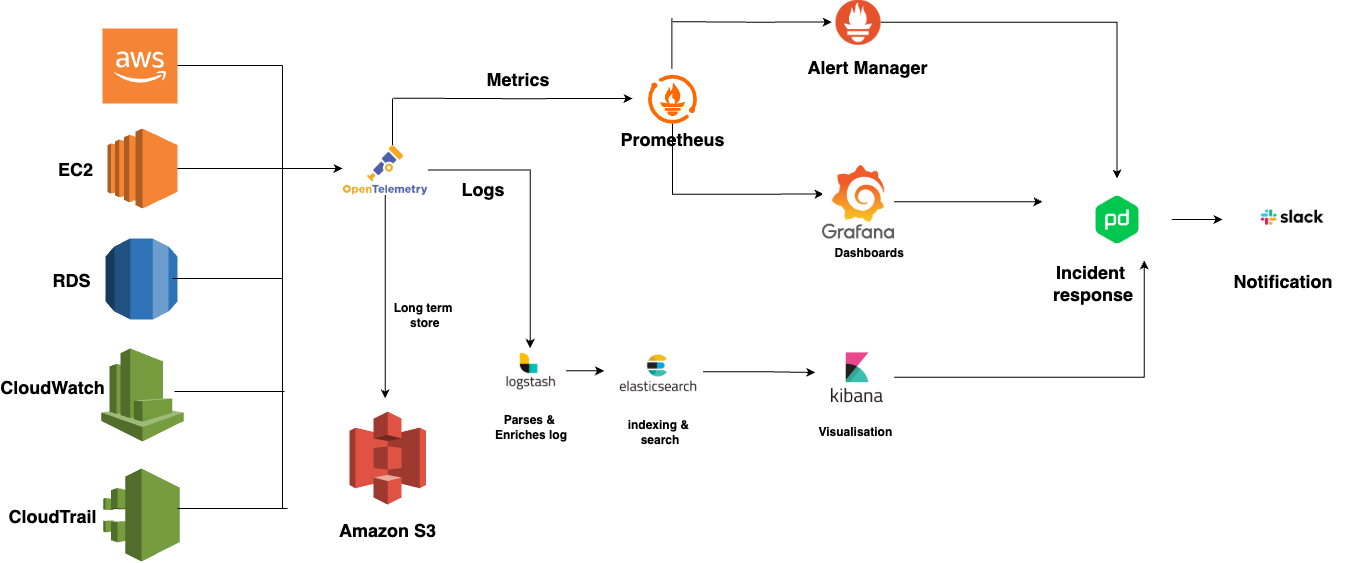
For observability, the platform integrates Amazon CloudWatch, Amazon SNS, and Amazon Athena, complemented by Prometheus and Grafana for metrics visualization and the ELK stack (Elasticsearch, Logstash, Kibana) for centralized log analysis. Together, these services deliver unified dashboards, deep operational visibility, and faster incident resolution.
Environment Setup
Each customer stack resides in its own AWS account with the same set of Infrastructure.
Implemented environment isolation with dedicated VPCs, subnets, and IAM roles per stack to enhance security and minimize cross-environment impact.
Networking
Designed secure VPC architectures with public/private subnets, NAT gateways, and route tables to isolate workloads and control traffic flow.
Implemented multi-AZ Application Load Balancers and Route 53 DNS failover for high availability and seamless traffic distribution.
Enforced network security with Security Groups, NACLs, and VPC Flow Logs, ensuring fine-grained access control and continuous monitoring.
Database Layer
Deployed Amazon RDS for MySQL and PostgreSQL in Multi-AZ configuration, ensuring automated failover with minimal downtime during AZ failures.
Enabled automated backups, snapshots, and cross-AZ replication to strengthen durability and meet strict RPO/RTO requirements.
Configured read replicas across AZs for workload scaling, while cross-region replication provided disaster recovery and business continuity.
Security & Access Control
Implemented fine-grained IAM policies and role-based access controls, ensuring least-privilege access across AWS resources.
Centralized identity management with AWS SSO and MFA enforcement, strengthening authentication and reducing unauthorized access risks.
Secured sensitive credentials with AWS Secrets Manager and automated key rotation via KMS, eliminating hardcoded secrets in codebases.

Automation & Observability
Infrastructure Automation
Provisioned cloud infrastructure using Terraform and AWS CloudFormation, enabling consistent, repeatable, and version-controlled deployments.
Automated patching, scaling, and configuration management with AWS Systems Manager and Ansible, reducing manual overhead and errors.
Integrated IaC workflows into CI/CD pipelines, accelerating environment provisioning and reducing lead time for changes by 60%.
Monitoring & Logging
Centralized Monitoring & Alerting – Integrated CloudWatch with Prometheus and Grafana dashboards to proactively detect anomalies, enabling faster incident response.
Security & Compliance Visibility – Leveraged ELK stack to collect and analyze audit logs, improving traceability and compliance with security standards.
End-to-End Observability – Implemented OpenTelemetry for distributed tracing across microservices, enhancing root cause analysis and reducing MTTR.
Centralized Observability
A central Grafana server in a dedicated Tools AWS account, which is connected with all environments.
Provides unified dashboards aggregating metrics from all stacks.
DevSecOps Best Practices
Shift Security Left – Integrated automated code, dependency, and container image scanning into CI/CD pipelines to detect vulnerabilities early.
Secure Secrets & Access – Enforced least-privilege IAM policies and managed secrets with AWS Secrets Manager to eliminate hardcoded credentials.
Continuous Monitoring & Compliance – Implemented centralized logging and alerting with CloudWatch, ELK, and OTel to ensure real-time threat detection and audit readiness.