


Business Challenge
Splunk Cloud was facing issues with existing automation to meet rapidly growing customer business needs. The Splunk Cloud operations team required automation that is scalable, secure, self-healing, and easy to configure. The following were expected outcomes.
More efficient management of customer environments with greater consistency.
Ability to quickly scale and deploy changes across the entire fleet regardless of size.
Provisioning of new customer environments in minutes instead of days.
Customer Solution
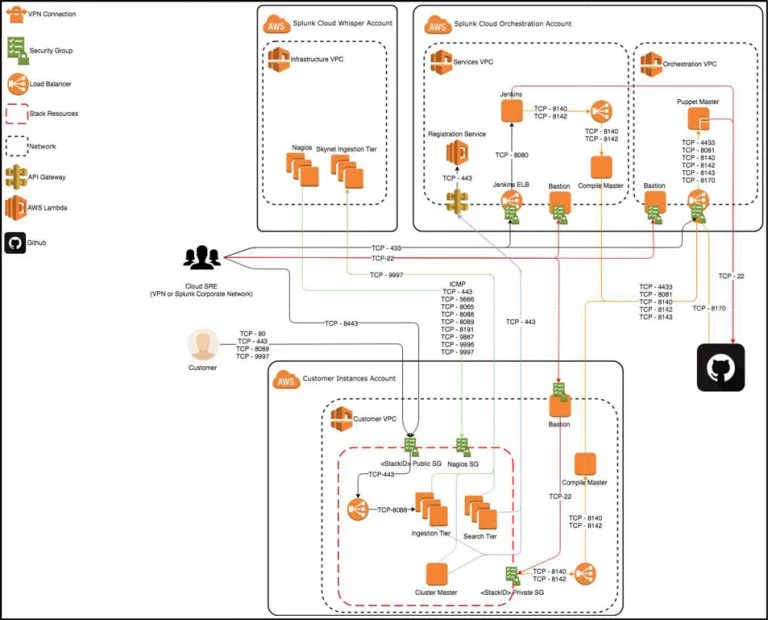
Crest Data helped the Splunk Cloud operations team in creating the next-generation automation system at scale. This solution architecture comprises various technologies like Terraform, Puppet, Kubernetes, Jenkins, etc.
Terraform was used to manage the entire infrastructure as a code.
Jenkins Parameterized Pipelines were used to deploy the Terraform written Infrastructure.
Puppet was used to configure a Splunk stack after the infrastructure was deployed.
This automation was then exposed using the HTTP API layer built using GO services and it was deployed on a Kubernetes cluster. A CLI and a UI were built on top of the API for its convenient use.
The Crest Difference
This next-generation automation system helped the Splunk Cloud Operations team achieve the demand for high and swift yet efficient scalability of their cloud environment at the rate customers’ businesses demand.
These technologies helped achieve automation at scale by managing the environment, preventing drift, and making changes easy to deploy across the entire fleet regardless of size.
It keeps the environment consistent and in the intended state.