
Instead of stopping at insight, they enable AI systems to execute. Not recommending the next step, actually take it.
And that difference is what separates experimentation from transformation.
Chatbots Think. Autonomous Systems Act.
Traditional GenAI tools are helpful. They draft. They summarize. They suggest. But someone still has to click the buttons.
An AI assistant might tell your IT team which ticket to prioritize. An autonomous system built through mature AI automation services can monitor systems, route incidents, trigger workflows, escalate based on policy, and close the loop, all within defined governance controls. The same applies in finance, cybersecurity, DevOps, and operations.
We are moving from AI as a productivity aid to AI as operational infrastructure. That shift isn’t cosmetic. It’s structural.
Why the Early Wave of AI Hit a Ceiling
According to McKinsey’s 2025 Global AI Survey, organizations report using AI in at least one function. Yet only a small percentage say it has significantly improved their bottom line.
Why?
Because most deployments never crossed the “action gap.”
They generated insights but didn’t integrate deeply enough into enterprise workflows to drive measurable outcomes.
You can’t transform operations with a sidebar chatbot.
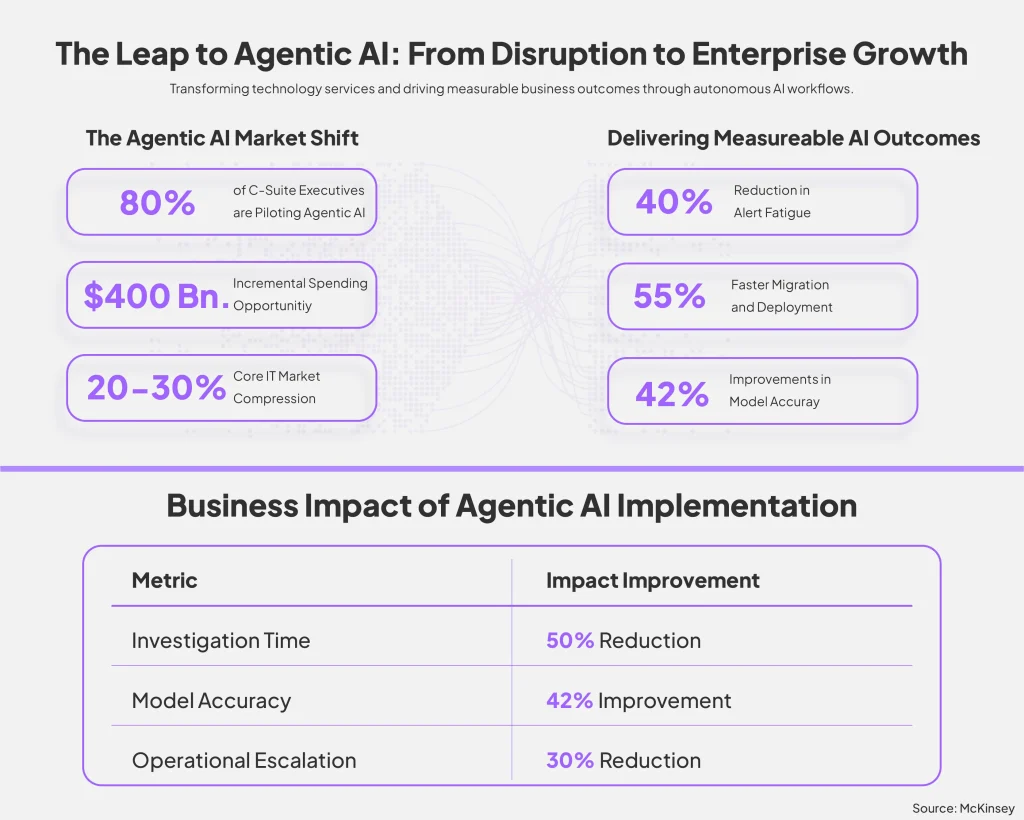
The economic upside of closing this execution gap is significant. Industry estimates suggest that moving from AI-assisted workflows to fully autonomous, execution-driven systems could unlock $100 billion to $400 billion in incremental enterprise value by the end of the decade (Source: McKinsey Agentic AI Report), as organizations transition from manual oversight to AI-powered operational infrastructure.
Closing that gap requires more than a model. It requires:
- Structured AI engineering services to build reliable, production-grade systems
- Purpose-built AI agent development services to design systems that execute tasks, not just respond
- Practical AI consulting for enterprises to align automation with governance and ROI
- A clearly defined plan through the enterprise GenAI roadmap services
Without that foundation, AI remains a pilot project. With it, AI becomes an execution engine.
The Real Barriers No One Talks About
Scaling AI automation services is not simple. And enterprises that pretend it are usually stall.
Three challenges show up almost every time.
First: Integration.
Enterprises are ecosystems of legacy systems, cloud services, APIs, compliance layers, and security frameworks. Getting autonomous agents to operate reliably across that environment requires serious engineering discipline. That’s where strong AI engineering services matter most.
Second: Skills.
Building multi-agent systems isn’t just about prompt engineering. It involves orchestration logic, MLOps pipelines, vector databases, CI/CD automation, and observability tooling. The talent pool is limited, and demand is rising.
Third: Trust.
A chatbot suggesting text is low risk.
An AI agent triggering a deployment or authorizing a transaction is not.
Human-in-the-loop checkpoints, audit logs, access controls, and performance monitoring aren’t optional; they’re foundational.
When enterprises embed those controls directly into their AI automation services, adoption accelerates because confidence increases.
(A New Framework for High-Impact AI)
What Changes When AI Actually Executes
Once execution enters the picture, impact becomes measurable.
In cybersecurity operations, autonomous systems have reduced alert fatigue by as much as 40% and cut investigation time nearly in half.
In IT operations, AI-driven observability has reduced complex migration deployment times by up to 90%.
These aren’t theoretical gains. They are operational improvements driven by systems that act, not just advise.
This is why AI agent development services have become central to enterprise transformation strategies. Agents designed for specific operational contexts, not generic chat interfaces, deliver compounding value. And none of it works without the infrastructure layer provided by disciplined AI engineering services.
Strategy Still Matters
Technology alone doesn’t create results. Enterprises that succeed don’t jump straight into deployment. They define scope, governance, and measurable outcomes first. That’s the role of structured AI consulting for enterprises.
A realistic transformation plan typically includes:
- Identifying execution-heavy workflows
- Mapping system integrations and dependencies
- Defining compliance guardrails
- Establishing monitoring and escalation thresholds
- Forecasting ROI based on operational metrics
When these steps are formalized into enterprise GenAI roadmap services, AI investments stop feeling experimental and start feeling accountable.
That accountability is what leadership cares about.
This Isn’t About Replacing People
There’s a persistent myth that autonomous AI eliminates human roles.
In reality, it changes them.
When repetitive execution tasks move to AI systems, human teams shift toward oversight, orchestration, exception management, and strategy. Employees stop chasing tickets and start managing systems.
The most successful deployments treat AI automation services as collaborative infrastructure not workforce replacement. Human-in-the-loop design isn’t just ethical. It’s practical.
The Enterprise Shift Is Already Underway
Across financial services, healthcare, retail, high tech, and manufacturing, enterprises are redesigning workflows around autonomous systems. They’re not abandoning AI assistants. They’re expanding beyond them.
The question has changed from:
“What can AI tell us?”
To:
“What can AI run for us?”
Organizations that combine structured AI automation services, scalable AI engineering services, and focused AI agent development services are already moving past pilot programs and into operational scale.
When that execution layer is guided by thoughtful AI consulting for enterprises and grounded in practical enterprise GenAI roadmap services, AI becomes less about hype and more about infrastructure.
At Crest Data, we’ve seen this shift firsthand. Enterprises don’t struggle with AI ideas; they struggle with execution. Turning ambition into operational systems requires disciplined engineering, clear governance, and measurable outcomes. That’s why our approach focuses on building production-ready AI ecosystems, combining structured AI automation services, scalable AI engineering services, and purpose-built AI agent development services. From early strategy through enterprise-scale deployment, we help organizations move from experimentation to accountable execution backed by practical AI consulting for enterprises and structured enterprise GenAI roadmap services.
Where This Is Headed
The future enterprise won’t just analyze data faster. It will act on it.
Not recklessly. Not without oversight. But continuously, intelligently, and within defined controls. That’s the promise of mature AI automation services; not smarter chat interfaces, but smarter systems that execute work across the organization. And once you see that difference clearly, it’s hard to go back to asking AI for suggestions instead of expecting it to deliver outcomes.
Autonomous execution isn’t the future, it’s already happening. If you’re ready to move beyond pilots and scale AI automation services that deliver real operational impact, let’s talk. Connect with us and start building systems that don’t just assist your business, they run it.