
AI Has Accelerated Integration Engineering. Domain Expertise Makes It Production-Ready
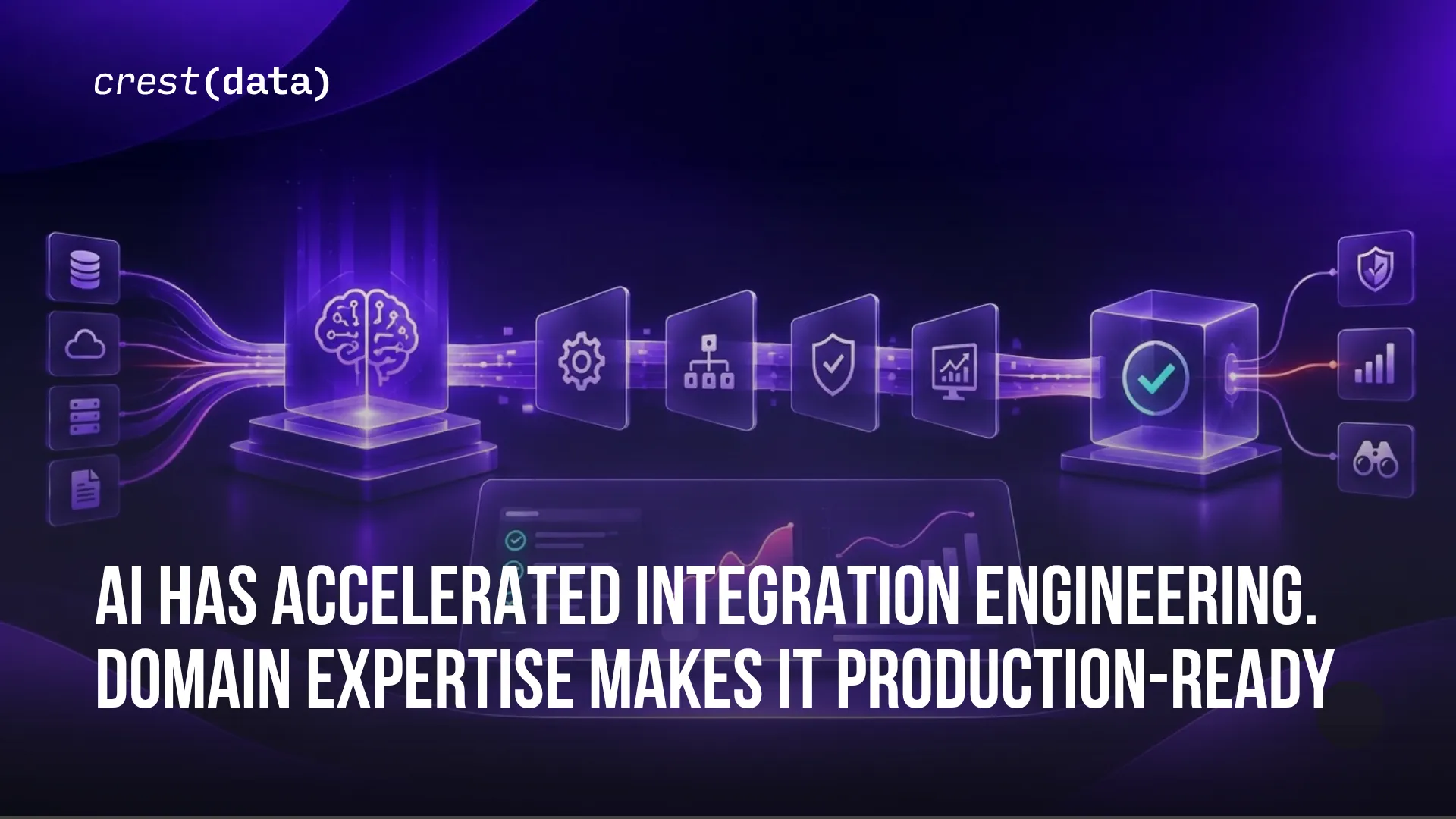
Security and observability platforms are only as good as the data that reaches them.
An integration looks simple: data moves from one product to another. In practice, it spans a collector, a parser, data model mapping, dashboards, detections, tests, documentation and ongoing maintenance.
This work once depended on a few engineers who knew which logs and metrics to collect, which dashboards and alerts teams would actually use, and where things break. AI now accelerates much of it. So the question is no longer whether AI can help, but what separates a production-ready integration from one that merely looks complete. More often than not, it is domain expertise, whether held by engineers or built into the AI itself.
Where AI is already making a difference
Much of integration engineering follows recognisable patterns, which is where AI has made the most visible difference.
Collectors. OAuth, token refresh, pagination, backoff and 429 Too Many Requests handling are well-established patterns that AI implements quickly and experienced reviewers can easily verify.
Parsing and mapping. AI drafts parsers and field mappings faster. Grounded in context (enriched schemas, field behaviour across event types, patterns from earlier integrations) rather than sample events alone, those mappings can be trusted, with less rework.
Content and translation. AI translates detections, dashboards and searches between query languages (e.g. SPL to KQL or YARA-L) and drafts consistent documentation. Generating new dashboards and alerts is just as quick; deciding which are worth building is another matter.
Test coverage. AI generates edge cases systematically and at scale (missing fields, unexpected values, oversized payloads, mixed timestamp formats), making broad coverage standard in every build.
The result: work that took weeks can now take days, freeing experienced engineers for the problems that genuinely need them.
Where domain expertise makes the difference
The difficulty is that the hardest parts of an integration often look like the easy parts. Whether AI gets them right depends less on the model itself and more on the domain expertise it has to draw on.
Knowing what to collect and build. Ingesting everything an API exposes inflates costs, buries useful signals in noise and can still miss data nobody thought to ask for. A SOC relies on a few firewall events, like denied connections and policy changes; an on-call team relies on a few database metrics, like replication lag. Knowing which logs, alerts and dashboards teams actually use takes domain expertise; API documentation alone cannot tell you. Without it, an integration can be technically flawless and still answer the wrong questions.
Undocumented API behaviour. Documentation outlines intended behaviour, but production reveals reality. For instance, a cursor-based collector might run smoothly until an endpoint silently caps result sets without warning. On high-volume days, often during critical incidents, events are skipped permanently while the collector reports success. AI working only from documentation cannot foresee this, whereas AI informed by real-world production patterns is far more likely to include defensive measures like count reconciliation or narrower time windows.
Semantics, not just syntax. Field names can be misleading. A user field might mean the principal in one event but something else in another. Mapping accurately requires product context. Standards like OCSF, ECS, UDM, CIM or OpenTelemetry help by making field definitions and event types clear, explicit, and consistent across tools.
Syntactically valid but semantically mismatched translations. Translating queries across platforms often yields syntactically correct code that misinterprets missing context like macros, lookup tables, or time windows. Differential testing, which replays identical data through both versions, is essential to verify semantic equivalence.
Access and sign-off. Requesting broad API scopes is easy, but setting least-privilege access, managing secrets, and assessing blast radius are critical security decisions. Likewise, deciding when an integration is production-ready requires experienced human judgment.
Loud errors and quiet errors
Years of building integrations for security and observability vendors have taught us one distinction that best guides how much to automate: whether a mistake will be loud or quiet.
A loud error announces itself: a failed build, rejected authentication, broken schema validation, an empty dashboard. Automated pipelines catch most of these, making them ideal for high AI autonomy.
A quiet error does not: a field mapped to the wrong meaning, a checkpoint that skips data, a translated detection matching subtly different events, an over-privileged token. Everything passes and looks healthy until the defect surfaces weeks later, often through a customer.
A third failure mode is not an error at all: an integration that works as designed but was designed around the wrong data. Dashboards nobody needs, alerts firing on noise, and the log that would have explained an incident never collected. No test catches this, because the integration meets its specification; only domain expertise can tell whether the specification was right.
The principle: let domain expertise shape what is collected and built, use AI for volume, validate automatically wherever results can be verified, and focus expert review on the ambiguous cases where quiet errors live. Experts then review a small share of the work, but the share that carries most of the risk.
| Integration area | Where AI helps | Where domain and integration expertise adds value |
|---|---|---|
| Data and content selection | Generating collectors, dashboards and alerts on request | Knowing which logs, metrics, dashboards and alerts actually matter to the teams using them |
| Collection | Auth, pagination, retries, backoff | Undocumented limits, truncation, checkpoint integrity |
| Parsing and mapping | Bulk mapping to a standard schema | Event classification and product-specific semantics |
| Content translation | Converting queries, detections and dashboards | Differential testing for equivalent results |
| Testing | Broad, generated edge-case coverage | Fixtures drawn from real production incidents |
| Access | Identifying the scopes an API requires | Least-privilege scoping, secret handling, blast radius |
| Documentation | Clear, consistent setup guides | Ensuring they reflect real product behaviour |
What production-ready looks like
Taken together, everything above comes down to a handful of qualities that separate integrations that hold up in production from those that only hold up in a demonstration.
- Grounded in real-world domain and integration experience. AI that draws on real integrations knows which data, dashboards and alerts teams actually rely on, and what has gone wrong before; AI working from documentation alone does not. That makes output useful, not merely complete.
- Self-validating. Output is automatically checked against platform best practices, schema conformance and expected results, and refined to a defined quality bar before anyone reviews it.
- Normalised to standards. Mapping to schemas such as OCSF and OpenTelemetry makes the meaning of data explicit, consistent and portable.
- Expert attention where it counts. Expert attention where it counts. Routine work moves fast; ambiguous cases go to experts who have seen them before.
- Maintained after release. Both products keep changing, so every integration needs an owner who tracks API and schema changes, updates mappings and reruns tests.
How this fits the bigger picture
In our experience, faster building is letting many vendors pursue integrations they could never prioritise. But coverage is only the first step. At Crest Data, we view integration ecosystems through a four-stage maturity model:
- Coverage. AI makes broad coverage achievable at a pace not previously realistic.
- Clarity. The right data, standard schemas, accurate semantics and clear capability descriptions make that coverage trustworthy.
- Operation. Ownership, monitoring, maintenance and regression testing keep it trustworthy as products evolve.
- Agent-ready. Well-described, well-governed integrations let AI agents and MCP-enabled platforms use them safely and effectively.
Most of the lasting value and effort sits in the three stages after coverage. As portfolios grow, that effort can no longer be applied one integration at a time, so domain expertise increasingly needs to be built into the AI and its validation.
Why this matters more in the agentic era
Integrations increasingly feed AI agents, not just dashboards. Agents take data at face value far more readily than experienced analysts, so a quiet error a person might have questioned becomes the basis of the agent’s reasoning. And an agent can only reason over what it is given: if the log that explains an incident was never collected, no reasoning will find it.
So while AI makes the build dramatically faster, AI agents make quality matter more than ever. The teams that benefit most will use AI for coverage while investing in the grounding, validation and expert review that keep results dependable.
Closing thought
AI has changed how integrations are built, mostly for the better, and now helps with much of the volume: collectors, mappings, translations and tests. What it cannot see alone is what documentation leaves out: which data matters to a SOC or on-call team, what a field really means in a given product, or how an API behaves on its busiest day. That takes domain expertise. The strongest integrations will pair AI’s speed and scale with the judgement that keeps them accurate, useful and dependable as products change. Increasingly, the best AI will carry that expertise with it, and the best engineers will know where it still falls short.
Where Crest Data can help
At Crest Data, we help security and observability vendors at every stage: identifying the integrations that matter most to their customers, building them with AI-powered engineering grounded in real-world integration experience, and keeping them accurate, maintained and agent-ready as products evolve. If you are shaping next year’s integration roadmap, our Integration Ecosystem Assessment is a practical place to start.
We will explore these ideas in our webinar, How Security and Observability Integrations Are Evolving for the Agentic Era, on 8 December 2026, with Netskope’s Gary Jenkins. Register here →
Thought Leader: Bhargav Nariyani