


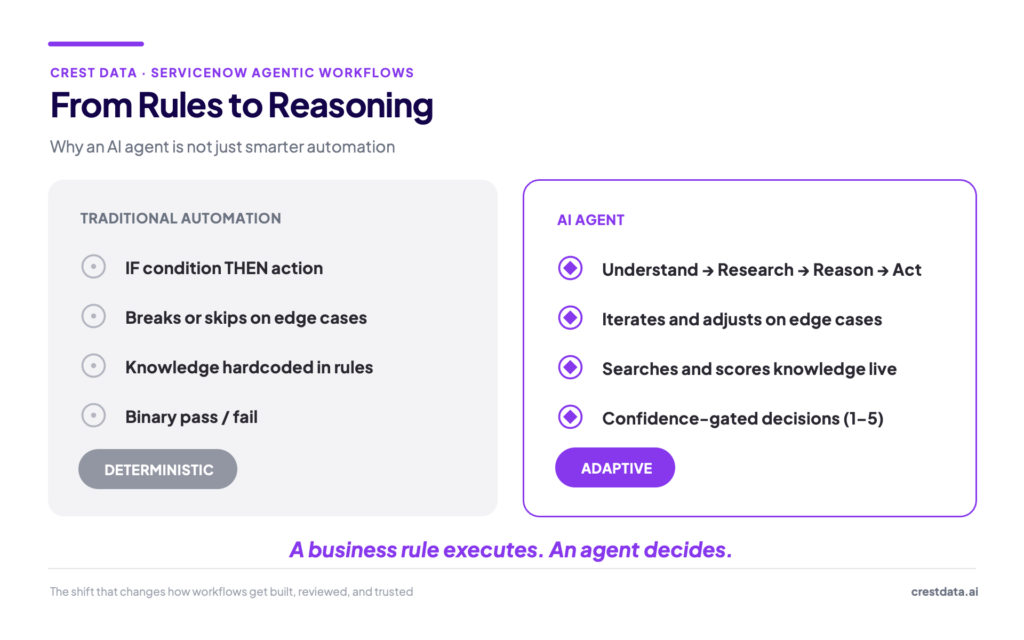
For fifteen years, automation on ServiceNow has meant one thing: rules -Business rules, assignment rules, flows, SLAs. You define a condition, you define an action, and the platform executes it the same way every time, forever. It’s predictable, it’s reviewable, and when it breaks, it breaks in ways you can reproduce.
AI agents are not that, and the first honest thing to say about them is that the difference took our own team a while to internalize, even though we work on this stuff daily.
The moment it clicked for us wasn’t a demo of an agent resolving a case. It was watching an agent decline to resolve one. It had researched the issue, drafted a solution, scored its own evidence, decided the confidence wasn’t there, and routed the case to a human with its findings attached. No rule told it to do that. It reasoned its way to “I’m not sure enough,” which is something no business rule has ever done.
A business rule executes. An agent decides.
That distinction sounds philosophical until you’re the one deploying agents into production. Then it becomes very practical, because everything you know about building, reviewing, and trusting ServiceNow workflow automation services was designed for things that execute, not things that decide.
What an agent actually is on the platform
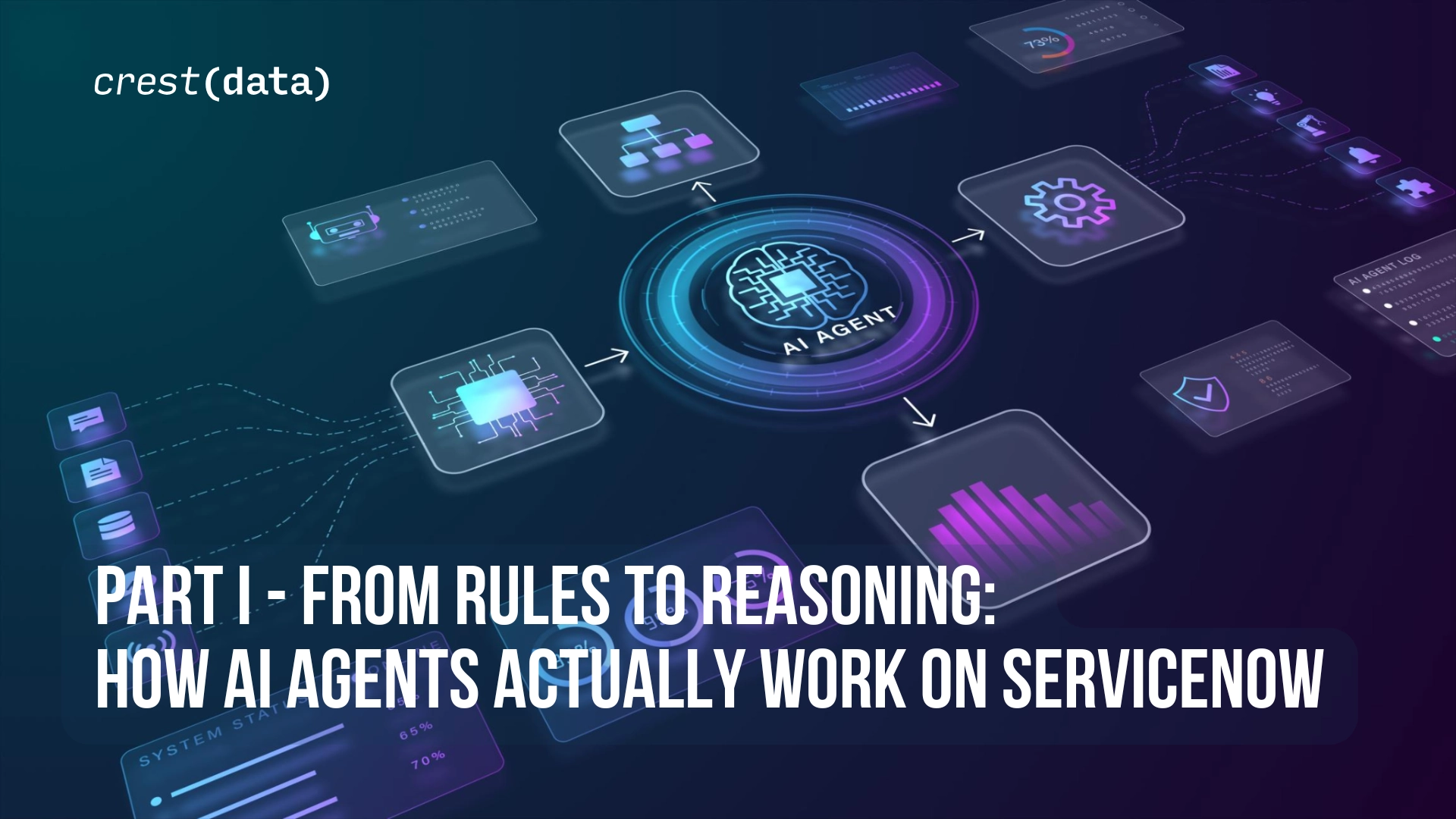
Strip away the buzzwords and an AI agent on ServiceNow is four things working together. We find it useful to give them plain names.
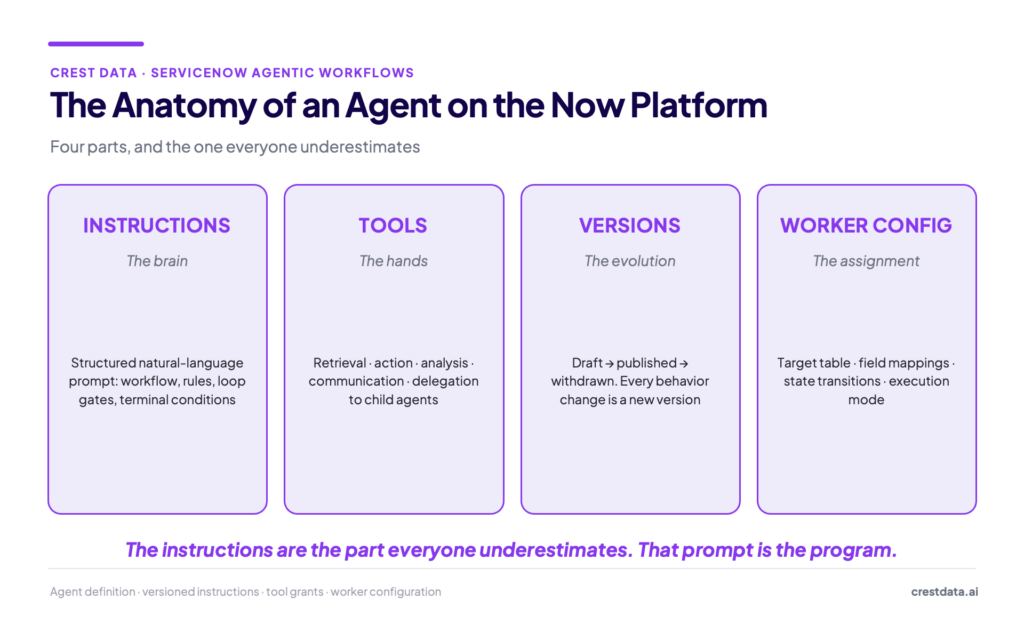
The instructions are the brain. A structured, natural-language prompt that defines the agent’s workflow, its rules, its decision logic, and its limits. This is the part everyone underestimates. Those instructions are the program, and writing them well turned out to be a genuine engineering discipline, not a writing exercise. More on that below.
The tools are the hands. Everything the agent can actually do: search knowledge bases, look up past cases, update records, post a solution, reassign a task, delegate to another agent. Each tool is a discrete capability, and the set you grant defines what the agent can touch.
Versions are the evolution. Every change to an agent’s behavior is a new version; draft, published, or withdrawn. Our most important agent is on its eighth version, and honestly, the withdrawn ones taught us more than the published ones. We’ll come back to that.
The worker configuration is the assignment. Which table the agent watches, which fields it reads and writes, how it transitions states, and critically its execution mode: fully autonomous, supervised with a human reviewing its recommendation, or copilot where the human keeps full control. That mode setting is really a trust dial, and where you set it should depend on evidence, not enthusiasm.
One case, start to finish
Here’s what actually happens when a case lands in front of one of our case-resolution agents, a real example of custom workflow automation in ServiceNow in production, simplified but honest.
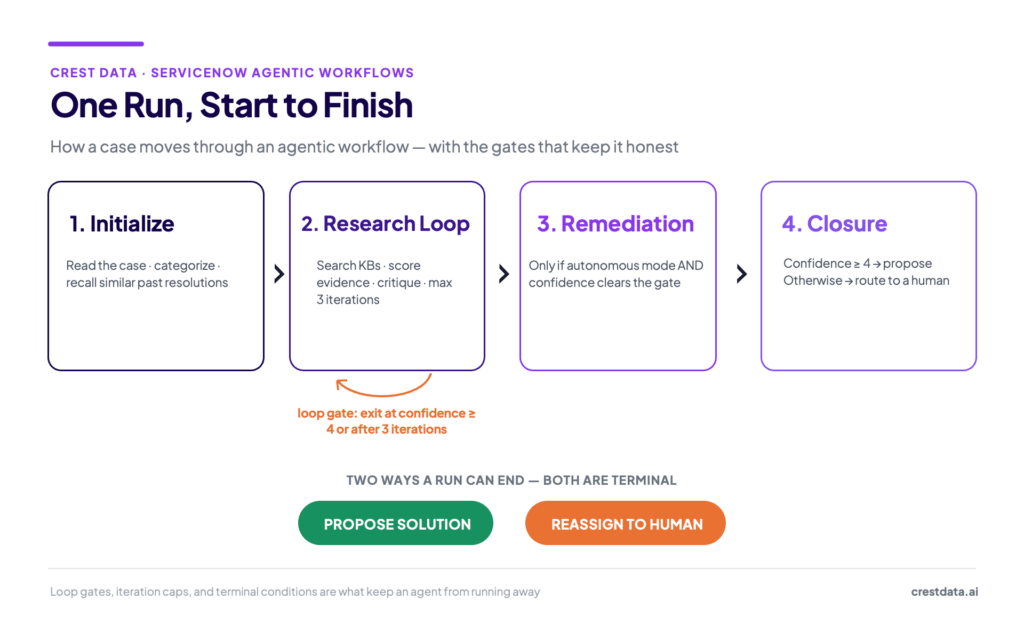
It starts by understanding. The agent reads the case, auto-categorizes it, checks whether this is something that should go straight to a human, and in our newer versions recalls how similar cases were resolved before.
Then it researches, in a loop. Search the knowledge bases. Load curated data sources. Score every article it finds for relevance. Draft candidate solutions. Then a separate step critiques the draft: are the citations real, is the solution actually grounded in the evidence, what’s the confidence on a scale of one to five? If confidence is high enough, the loop exits. If not, it iterates up to three times, and then it stops no matter what.
That cap matters more than it looks. One of our earliest lessons was that an agent without loop gates and terminal conditions will happily keep researching forever, burning time and tokens in pursuit of a certainty that isn’t coming. We now treat “how does this run end?” as the first design question, not the last. Every path through the instructions has to land on a terminal action, and once it does, the run is over. No further calls. Ever.
Then, maybe, it acts. Remediation actually executing a fix sits behind a double gate: the agent must be in autonomous mode and confidence must clear the threshold. Otherwise, the most it does is recommend.
And it always ends one of two ways. Propose the solution to the customer, or hand the case to a human with everything it learned attached. Both are terminal. Both are legitimate outcomes. Internalizing that second part changed how we design: a well-reasoned handoff is a success, not a failure.
It took a team, not a genius
Our first designs used a single agent that did everything: research, evaluate, decide, act. It didn’t work, and the reason is worth understanding because it’s not obvious up front. An agent that generates a solution is a terrible judge of that solution. The same reasoning that produced the answer will defend it. We needed separation of concerns, the same principle we’d apply to any system, applied to reasoning itself.
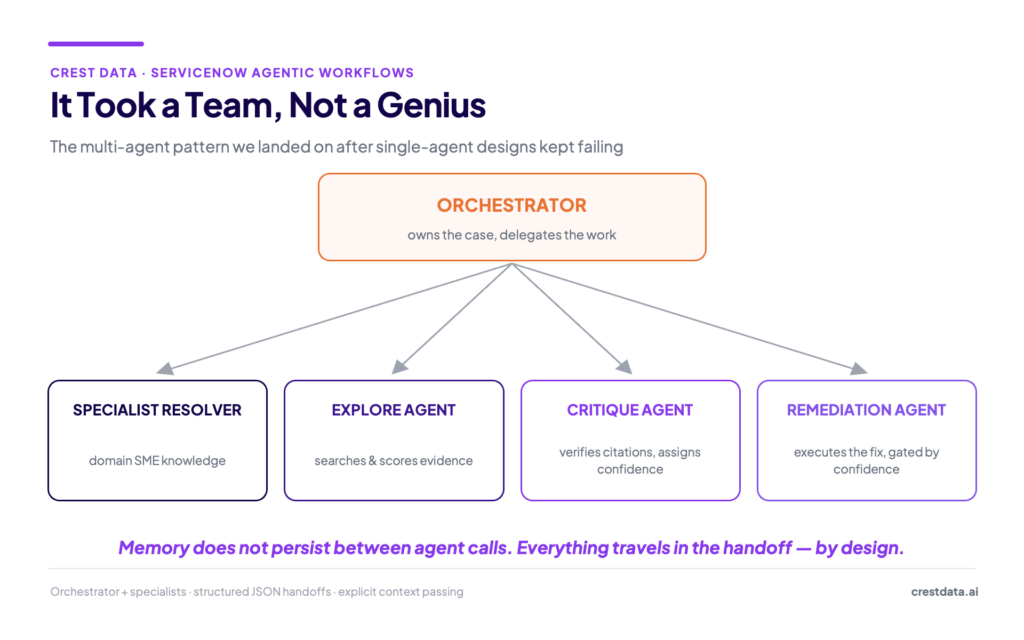
So the architecture that survived is a team. An orchestrator owns the case and delegates. An explore agent searches and scores evidence. A critique agent deliberately separates, verifies citations, and assigns confidence. Specialist agents carry domain knowledge. And a remediation agent, gated hardest of all, executes fixes.
One design decision here surprises people: memory does not persist between agent calls. Every handoff is an explicit, structured JSON payload: the case, the findings so far, the gaps. If it’s not in the handoff, the next agent doesn’t know it. That felt like a limitation at first. We now think of it as a feature, because it forces every piece of context to be visible, inspectable, and deliberate. Nothing travels implicitly, which means nothing important can hide.
The agent that says “I don’t know”
If you take one engineering idea from this post, take this one. The thing that makes an agent trustworthy isn’t how often it answers. It’s how well it knows when not to.
In our case-resolution work, every candidate solution gets scored on four dimensions before anything reaches a customer. How strong is the evidence of authoritative sources, multiple confirmations, a fix verified in a closed case? How well does the solution actually fit the symptoms, the root cause, this customer’s environment? How safe is it to execute low risk, reversible, no admin access required? And how much uncertainty is in the picture of conflicting documents, sparse evidence, ambiguous wording?
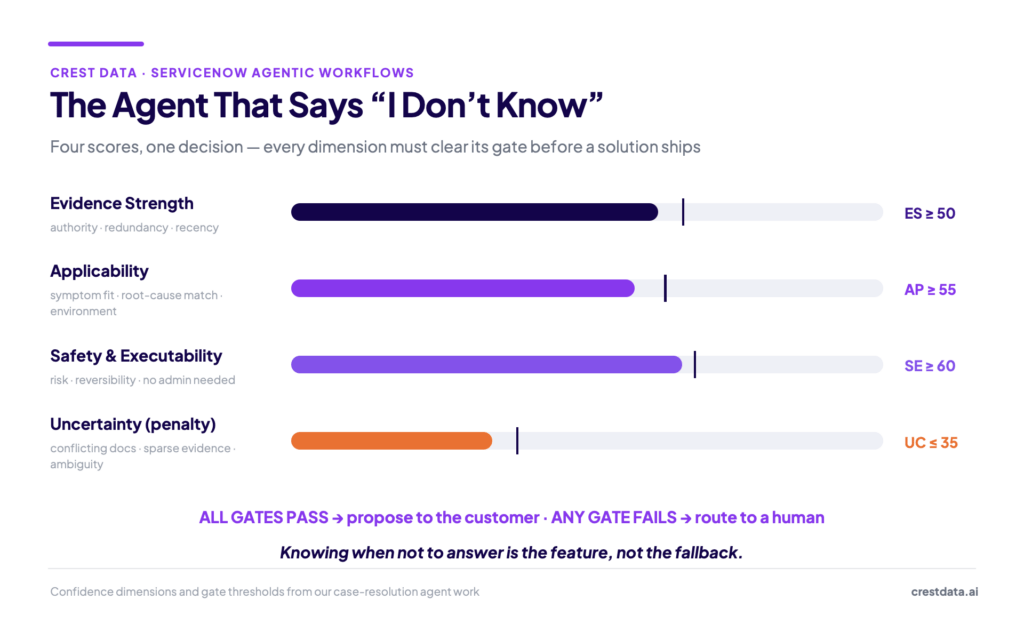
Every dimension has a gate, and all of them must pass. One fails, and the case goes to a human with the research attached, so the human starts from the agent’s findings instead of from zero. We’ve come to describe it this way internally: knowing when not to answer is the feature, not the fallback. The agents our support engineers actually trust are the ones that escalate well, and that single principle has reshaped how to implement ServiceNow for enterprise IT agent workflows across our practice.
Eight versions to get it right
Theory is easy. Here’s what it actually took. One case-resolution agent we’ve been engineering built to take routine support cases from intake to resolution, end to end has been through eight versions, and the honest history is more instructive than any architecture diagram.
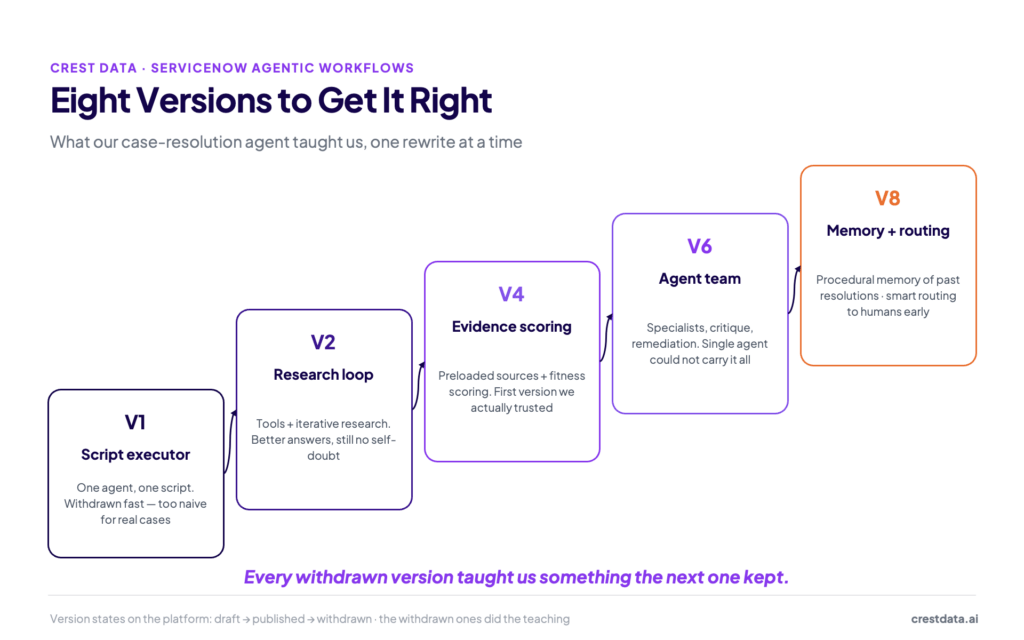
Version one was a single agent with a script executor. It was withdrawn quickly, and deservedly; real cases are messier than any script anticipates. Version two added tools and the research loop better answers, but the agent still had no capacity for self-doubt, and an agent without self-doubt is a liability in production. The version we first actually trusted, and the one that reshaped how we think about enterprise ServiceNow implementation services for AI agents, was the one that added evidence scoring: preloaded data sources and a fitness score for every candidate solution. That’s when “how confident are you?” became a number instead of a vibe.
Then came the move to a multi-agent team, because one agent genuinely could not carry research, critique, and remediation at once. And the latest version added the two things we’d been missing without realizing it: procedural memory, so the agent recalls how similar cases were resolved before, and smarter routing, so cases that need a human go to one early instead of after three wasted research loops.
The pattern across all eight: every withdrawn version taught us something the next one kept. If your first agent design survives contact with production, you’re either very good or you’re not looking closely enough. We were not very good. We looked closely.
What we’re still learning
A few things we haven’t fully cracked, since a series like this should be a working account and not a brochure, and since honest ServiceNow consulting services work depends on saying so out loud. Writing instructions is still more craft than science; two phrasings that read identically to us can produce meaningfully different agent behavior, and we catch that through testing, not intuition. Confidence thresholds need periodic re-tuning as knowledge bases evolve and set-and-forget doesn’t hold. And deciding which cases belong in autonomous mode versus supervised is a judgment call we still make conservatively, because winning back a customer’s trust after one bad autonomous answer costs more than a hundred good ones earned.
If you remember five things
- A rule executes; an agent decides. Everything about building and trusting workflows changes at that line.
- The instructions are the program. Structured steps, loop gates, and terminal conditions are engineering, not prose.
- Separate the generator from the judge. An agent that critiques its own answers will defend them. Ours don’t get to.
- Confidence must be a number with a gate. Four dimensions, hard thresholds, and a human path when any gate fails.
- Escalating well is a success. The agents people trust are the ones that know when not to answer.
Where this series goes next
Everything in this post is about making agents capable and capability, we’ve learned, is the easy half. Because the moment an agent can decide and act on a production instance, two harder questions walk in behind it.
The first: who approved that agent? Every script on your instance goes through change control. Agents, in most organizations, ship through a side door instructions unreviewed, tool grants uncomputed, reach unknown. Part 2 of this series is about the pre-deployment governance gate we believe every agent needs, and the analyzer we built in our labs to prove it works.
The second: once agents are running, how do you actually know how they’re doing? Not whether they ran how well they reasoned, whether they’re drifting, what a resolution costs. That’s Part 3.
Build them well. Gate them before they ship. See what they’re really doing. That’s the whole series, and in our experience, it’s the order in which enterprise trust gets earned.
Part 2 will talk about the pre-deployment governance gate every agent needs before it touches a production instance, and the analyzer our labs built to enforce it. If your team is already thinking about how to build, review, and trust AI agents on the Now Platform, and you want a ServiceNow implementation partner who has taken this from first principles into production, Crest Data’s engineering team is happy to compare notes.
Talk to us about what a ServiceNow solutions provider engagement looks like for agent-driven workflows, and we will show you what we’ve shipped, what we’ve withdrawn, and what we would do differently on day one.
Thought Leader: Dhaval Bhimani