Skip links

Accelerated migration to Amazon CloudWatch

Splunk to Amazon CloudWatch Migrations

Accelerate migrations, lower costs, and reduce complexity

Overview

Splunk to Amazon CloudWatch Migrations

Crest Data’s Splunk-to-Amazon CloudWatch migration service accelerates timelines by over 60% while reducing cost, risk, and complexity.

Get Started

This service is delivered by our experts proficient in both Splunk and Amazon CloudWatch, leveraging our migration engine to automatically convert Splunk dashboards and alerts into CloudWatch equivalents, while preserving critical DevOps and incident management workflows through data integrity, tags, and configurations.

Highlights

Features at a Glance

Accelerated migration

Crest Data’s migration engine to automatically convert dashboards and alerts from Splunk to Amazon CloudWatch

Cost Savings

60% cost savings vs. in-house or generalist services

Expert-level resources

Deep in-house expertise with both Splunk and Amazon CloudWatch.

Product Snapshots

Inside the Splunk to CloudWatch Migration

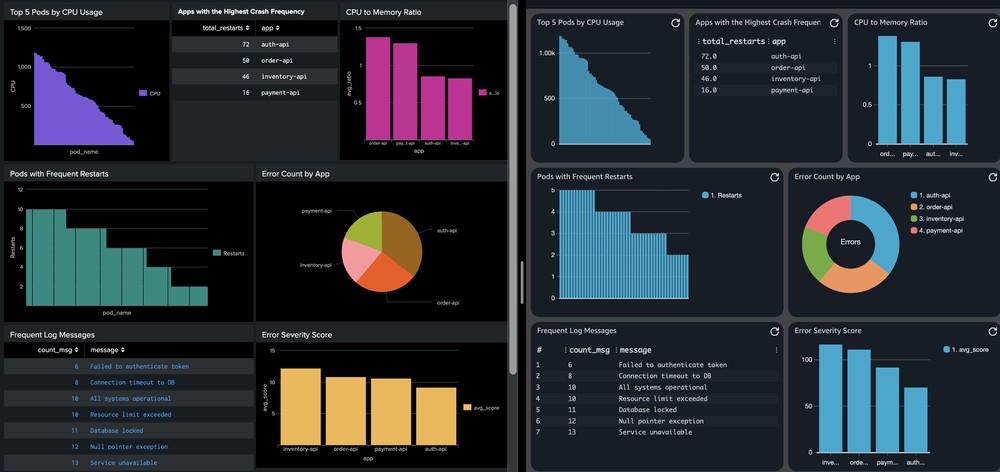
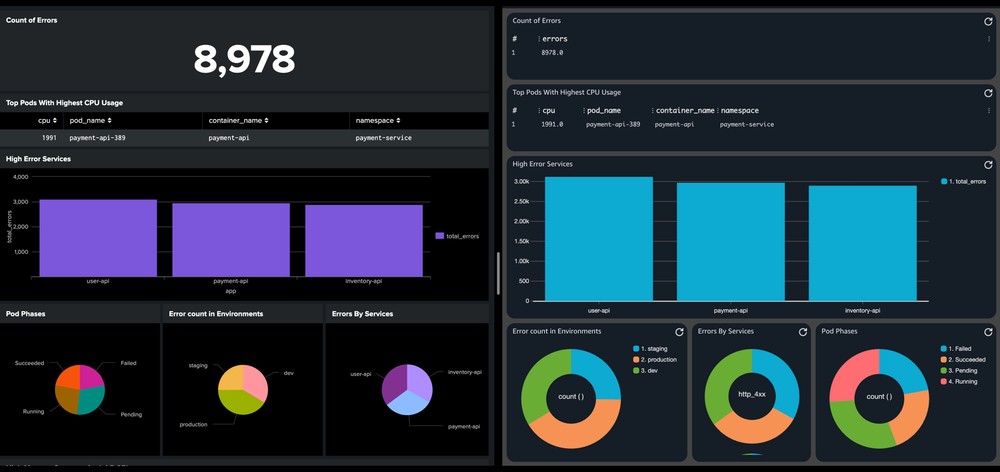
A screen-by-screen look at how your Splunk dashboards and alerts come across into Amazon CloudWatch.

1 / 2
Observability Insights view in the Splunk to Amazon CloudWatch migration
01

Observability Insights

Cluster Health view in the Splunk to Amazon CloudWatch migration
02

Cluster Health

Why Choose Crest Data

Expertise, automation, and dedicated support for every CloudWatch migration

Industry-Leading Expertise

  • With over 100 migrations delivered across various observability, SIEM and cloud platforms
  • Crest Data has earned a reputation as a trusted partner

Implementation Excellence

  • Get tailored guidance from our experts
  • To ensure a smooth, successful migration

Built for What’s Next

  • Stay ahead with solutions that evolve
  • To support the latest features and capabilities

Ready to migrate?

Talk to our migration experts and kick off your Splunk to Amazon CloudWatch journey with confidence.

CloudWatch Migration by the Numbers

Scale that backs every Splunk to Amazon CloudWatch migration

0
Faster migration timelines.
0
Cost savings vs. in-house or generalist services.
0
Migrations delivered across observability, SIEM and cloud platforms.
Frequently Asked Questions

Splunk to Amazon CloudWatch Migration FAQs

Answers to the questions we hear most often about migrating from Splunk to Amazon CloudWatch with Crest Data.

  • Amazon CloudWatch is AWS’s native monitoring and observability service. It collects and tracks metrics, logs, and events from AWS services, custom applications, and on-premises resources — providing a unified operational view of your AWS environment.

    CloudWatch includes dashboards for visualizing resource health, alarms for automated notifications and operational responses, Logs Insights for log querying and analysis, and Container Insights for Kubernetes and ECS workloads. For organizations running workloads primarily on AWS, CloudWatch provides deep native integration with the services they already use. Crest Data’s migration service handles the full transition from Splunk to CloudWatch — converting dashboards, alerts, and log queries while preserving your existing monitoring workflows.

  • Amazon CloudWatch serves several core observability functions:

    • Metrics collection — automatically collects performance metrics from all AWS services (EC2, Lambda, RDS, EKS, and more) as well as custom application metrics.
    • Log management — ingests, stores, and enables querying of log data via CloudWatch Logs and Logs Insights.
    • Alarms and notifications — triggers alerts based on metric thresholds and sends notifications through SNS, email, or third-party integrations.
    • Dashboards — provides customizable operational dashboards for monitoring AWS resource health and application performance.
    • Container monitoring — offers Container Insights for detailed monitoring of EKS and ECS environments.

    During a Splunk to CloudWatch migration, Crest Data maps each of your existing Splunk monitoring capabilities to the corresponding CloudWatch feature, ensuring nothing is lost in the transition.

  • Amazon CloudWatch includes a free tier that covers basic monitoring for AWS services, including standard metrics at 5-minute intervals, 10 alarm metrics, 3 dashboards with up to 50 metrics each, and 5GB of log data ingestion and storage per month. Detailed monitoring, custom metrics, additional dashboards, and Logs Insights queries are available on a pay-as-you-go basis beyond the free tier.

    CloudWatch’s pricing is usage-based and scales with your AWS footprint, which means costs are closely tied to your actual monitoring activity. As part of every Splunk to CloudWatch migration, Crest Data provides a cost modelling exercise to help you estimate your expected CloudWatch spend based on your current Splunk data volumes and monitoring scope.

  • Amazon CloudWatch Logs is the log management component of CloudWatch. It ingests, stores, and enables real-time monitoring and analysis of log data from AWS services, EC2 instances, Lambda functions, containerized applications, and custom sources via the CloudWatch Agent or API.

    CloudWatch Logs includes Logs Insights, a purpose-built query interface for interactive log analysis, and supports metric filters that can convert log patterns into CloudWatch metrics for alarming and dashboarding. Log retention is fully configurable, from 1 day to 10 years. During a Splunk to CloudWatch migration, Crest Data converts your Splunk saved searches and dashboards into Logs Insights queries and CloudWatch Dashboard widgets, maintaining full equivalence with your existing log monitoring setup.


  • Amazon CloudWatch retains metric data at different resolutions and durations:

    • High-resolution metrics (1-second) — retained for 3 hours
    • Detailed metrics (1-minute) — retained for 15 days
    • Standard metrics (5-minute) — retained for 63 days
    • Low-resolution metrics (1-hour) — retained for 15 months

    CloudWatch Logs retention is fully configurable per log group — from 1 day to 10 years, or set to never expire. For long-term log archival beyond standard retention windows, logs can be exported to Amazon S3 at low storage cost.

    Data retention requirements are an important part of any Splunk to CloudWatch migration planning. Crest Data’s migration assessment includes a review of your current Splunk retention policies and maps them to the appropriate CloudWatch configuration.

Get Started

Start your Splunk to Amazon CloudWatch migration today

Talk to our migration experts about your environment. Every engagement begins with a detailed assessment and a phased migration roadmap.